

WHAT IS AN
ACL TEAR?
The ACL is one of the most important — and most injured — ligaments in the body. Understanding what it does and how it tears is the foundation of prevention.
THE KNEE'S
CONTROL CENTER
Your knee is held together by four major ligaments. The Anterior Cruciate Ligament (ACL) runs diagonally through the center of the knee, connecting the femur (thigh bone) to the tibia (shin bone).
Its primary job is to prevent the tibia from sliding forward relative to the femur and to control rotational stability. Every time you cut, pivot, land from a jump, or change direction, the ACL is working hard to keep your knee stable.
The ACL can withstand roughly 2,000 Newtons (~450 lbs) of force before tearing. In high-speed soccer movements, forces approaching this limit are common — which is why proper mechanics matter so much.
Knee Joint — Anterior View (front)
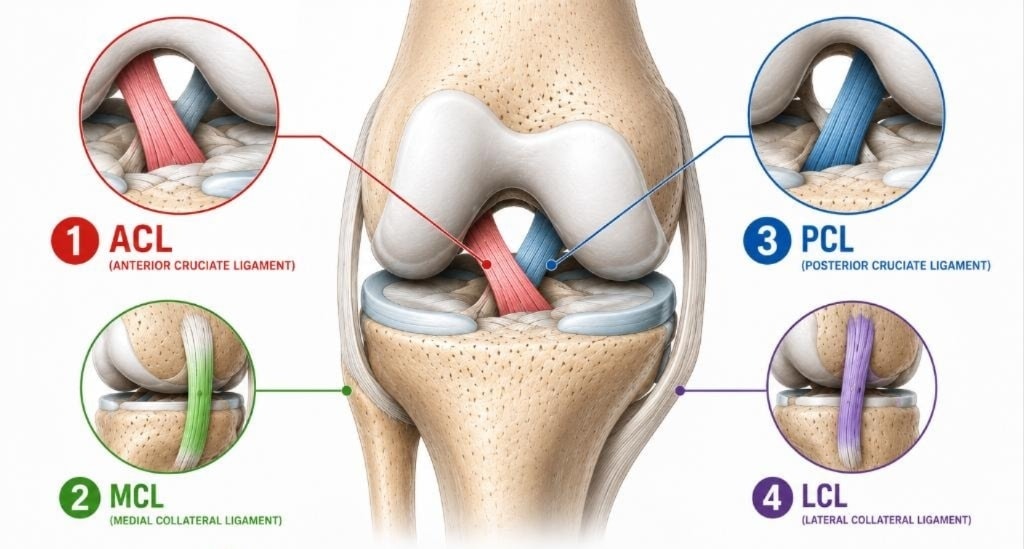
Runs diagonally through the center of the knee, connecting the femur to the tibia. Controls forward movement and rotational stability — the most commonly torn ligament in soccer.
Located just behind the ACL, the PCL prevents the tibia from sliding backward. It is stronger than the ACL and less commonly injured, typically from direct impact to the front of the knee.
Runs along the inner (medial) side of the knee, connecting the femur to the tibia. It resists forces that push the knee inward and provides side-to-side stability during cutting and contact.
Located on the outer (lateral) side of the knee, connecting the femur to the fibula. It stabilizes the knee against outward forces and is the least commonly injured of the four major ligaments.
HOW DOES AN ACL TEAR?
Non-Contact
The majority of ACL tears happen without any contact. A sudden stop, pivot, or awkward landing generates enough force to rupture the ligament on its own.
- Cutting away from a defender
- Landing from a header
- Sudden deceleration to receive a pass
Contact
A direct blow to the knee — typically from a tackle or collision — forces the knee into a valgus (inward) position, tearing the ACL.
- Slide tackle to the outer knee
- Collision with another player
- Awkward fall with contact
Preventable
Research shows that structured neuromuscular training programs can reduce ACL injury rates by up to 50% — primarily by addressing the non-contact mechanisms.
- FIFA 11+ warm-up program
- Landing mechanics training
- Hip and hamstring strengthening
WHAT DOES AN ACL
TEAR FEEL LIKE?
ACL tears are often dramatic — athletes frequently describe hearing or feeling a loud "pop" at the moment of injury. However, symptoms can vary based on the severity of the tear (partial vs. complete) and whether other structures were also damaged.
Important: Only an MRI can confirm an ACL tear. If you suspect an ACL injury, stop playing immediately and seek medical evaluation. Continuing to play on a torn ACL can cause additional damage to the meniscus and cartilage.
ACL Tear Grades
Mild sprain — ligament is stretched but intact. Usually heals with rest.
Partial tear — ligament is partially torn. May require surgery depending on activity level.
Complete tear — ligament is fully ruptured. Surgery is typically recommended for active athletes.
RECOVERY IS LONG,
HARD, AND EXPENSIVE.
An ACL tear is not a minor setback. For young athletes, it means months away from the sport they love — and a road back that demands as much mental toughness as physical effort. This is exactly why prevention matters.
Average recovery time before returning to competitive play
Estimated total cost of surgery, rehab, and follow-up care
Athletes who re-tear their ACL within two years of returning to sport
The bottom line: Surgery, physical therapy, and the psychological toll of watching your season — and possibly your teammates — move on without you is a reality many young athletes are not prepared for. Prevention is not just smarter. It is the only strategy that keeps you on the field.
NOW YOU KNOW WHAT IT IS.
LET'S PREVENT IT.
Understanding the ACL is step one. Step two is learning why tears happen — and step three is doing something about it.